Timings and parallelization
This section summarizes the options DFTK offers to monitor and influence performance of the code. For details on running DFTK on HPC systems, see also Using DFTK on compute clusters and Using DFTK on GPUs.
Timing measurements
By default DFTK uses TimerOutputs.jl to record timings, memory allocations and the number of calls for selected routines inside the code. These numbers are accessible in the object DFTK.timer. Since the timings are automatically accumulated inside this datastructure, any timing measurement should first reset this timer before running the calculation of interest.
For example to measure the timing of an SCF:
DFTK.reset_timer!(DFTK.timer)
scfres = self_consistent_field(basis, tol=1e-5)

DFTK.timer
────────────────────────────────────────────────────────────────────────────────
Time Allocations
─────────────────────── ────────────────────────
Tot / % measured: 304ms / 36.8% 79.6MiB / 59.0%
Section ncalls time %tot avg alloc %tot avg
────────────────────────────────────────────────────────────────────────────────
self_consistent_field 1 112ms 100.0% 112ms 46.9MiB 100.0% 46.9MiB
lobpcg_hyper 24 57.4ms 51.3% 2.39ms 10.2MiB 21.7% 435KiB
matvec 67 48.8ms 43.6% 728μs 3.32MiB 7.1% 50.8KiB
DftHamiltoni... 67 48.8ms 43.6% 728μs 3.32MiB 7.1% 50.7KiB
local 441 47.4ms 42.4% 108μs 27.6KiB 0.1% 64.0B
nonlocal 67 745μs 0.7% 11.1μs 284KiB 0.6% 4.24KiB
rayleigh_ritz 43 2.59ms 2.3% 60.2μs 1.01MiB 2.1% 23.9KiB
ortho! X vs Y 62 2.53ms 2.3% 40.8μs 1.08MiB 2.3% 17.9KiB
ortho! 132 1.46ms 1.3% 11.1μs 834KiB 1.7% 6.32KiB
ortho! 24 426μs 0.4% 17.7μs 496KiB 1.0% 20.7KiB
preconditioning 67 239μs 0.2% 3.57μs 18.2KiB 0.0% 279B
Update residuals 67 195μs 0.2% 2.90μs 32.5KiB 0.1% 497B
compute_density 8 26.5ms 23.7% 3.32ms 5.12MiB 10.9% 655KiB
symmetrize_ρ 8 21.6ms 19.3% 2.70ms 3.96MiB 8.4% 507KiB
energy_hamiltonian 9 13.9ms 12.4% 1.54ms 13.7MiB 29.2% 1.52MiB
ene_ops 9 12.0ms 10.7% 1.33ms 10.2MiB 21.7% 1.13MiB
ene_ops: xc 9 9.81ms 8.8% 1.09ms 5.00MiB 10.6% 568KiB
ene_ops: har... 9 1.43ms 1.3% 158μs 4.06MiB 8.6% 462KiB
ene_ops: non... 9 230μs 0.2% 25.6μs 132KiB 0.3% 14.6KiB
ene_ops: kin... 9 175μs 0.2% 19.5μs 86.3KiB 0.2% 9.59KiB
ene_ops: local 9 138μs 0.1% 15.3μs 843KiB 1.8% 93.7KiB
energy 8 8.67ms 7.8% 1.08ms 7.58MiB 16.2% 971KiB
energy: xc 8 6.64ms 5.9% 829μs 2.95MiB 6.3% 378KiB
ene_ops: hartree 8 1.20ms 1.1% 151μs 3.61MiB 7.7% 462KiB
ene_ops: nonlocal 8 269μs 0.2% 33.6μs 132KiB 0.3% 16.5KiB
ene_ops: kinetic 8 193μs 0.2% 24.1μs 78.1KiB 0.2% 9.77KiB
ene_ops: local 8 167μs 0.1% 20.9μs 749KiB 1.6% 93.7KiB
Anderson acceler... 7 1.87ms 1.7% 267μs 3.42MiB 7.3% 500KiB
ortho_qr 3 149μs 0.1% 49.6μs 101KiB 0.2% 33.7KiB
χ0Mixing 8 100μs 0.1% 12.4μs 27.0KiB 0.1% 3.38KiB
────────────────────────────────────────────────────────────────────────────────The output produced when printing or displaying the DFTK.timer now shows a nice table summarising total time and allocations as well as a breakdown over individual routines.
Timing measurements have the unfortunate disadvantage that they alter the way stack traces look making it sometimes harder to find errors when debugging. For this reason timing measurements can be disabled completely (i.e. not even compiled into the code) by setting the package-level preference DFTK.set_timer_enabled!(false). You will need to restart your Julia session afterwards to take this into account.
Rough timing estimates
A very (very) rough estimate of the time per SCF step (in seconds) can be obtained with the following function. The function assumes that FFTs are the limiting operation and that no parallelisation is employed.
function estimate_time_per_scf_step(basis::PlaneWaveBasis)
    # Super rough figure from various tests on cluster, laptops, ... on a 128^3 FFT grid.
    time_per_FFT_per_grid_point = 30 #= ms =# / 1000 / 128^3

    (time_per_FFT_per_grid_point
     * prod(basis.fft_size)
     * length(basis.kpoints)
     * div(basis.model.n_electrons, DFTK.filled_occupation(basis.model), RoundUp)
     * 8  # mean number of FFT steps per state per k-point per iteration
     )
end

"Time per SCF (s):  $(estimate_time_per_scf_step(basis))"
"Time per SCF (s): 0.008009033203124998"Options for parallelization
At the moment DFTK offers two ways to parallelize a calculation, firstly shared-memory parallelism using threading and secondly multiprocessing using MPI (via the MPI.jl Julia interface). MPI-based parallelism is currently only over $k$-points, such that it cannot be used for calculations with only a single $k$-point. There is also support for Using DFTK on GPUs.
The scaling of both forms of parallelism for a number of test cases is demonstrated in the following figure. These values were obtained using DFTK version 0.1.17 and Julia 1.6 and the precise scalings will likely be different depending on architecture, DFTK or Julia version. The rough trends should, however, be similar.
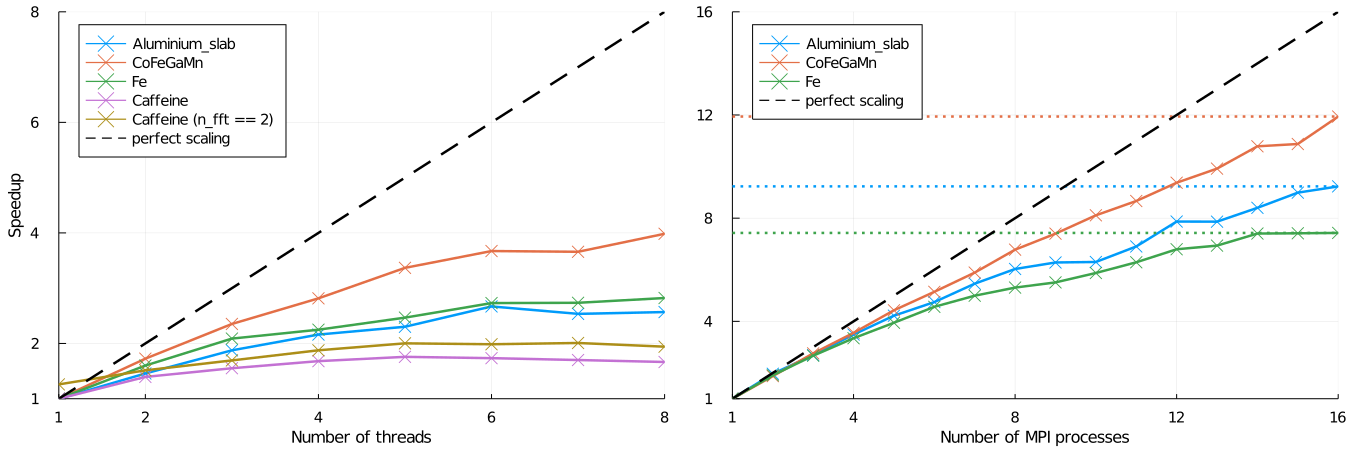
The MPI-based parallelization strategy clearly shows a superior scaling and should be preferred if available.
MPI-based parallelism
Currently DFTK uses MPI to distribute on $k$-points only. This implies that calculations with only a single $k$-point cannot use make use of this. For details on setting up and configuring MPI with Julia see the MPI.jl documentation.
First disable all threading inside DFTK, by adding the following to your script running the DFTK calculation:
using DFTK
disable_threading()
Run Julia in parallel using the
mpiexecjlwrapper script from MPI.jl:mpiexecjl -np 16 julia myscript.jlIn this
-np 16tells MPI to use 16 processes and-t 1tells Julia to use one thread only. Notice that we usempiexecjlto automatically select thempiexeccompatible with the MPI version used by MPI.jl.
As usual with MPI printing will be garbled. You can use
DFTK.mpi_master() || (redirect_stdout(); redirect_stderr())at the top of your script to disable printing on all processes but one.
While most standard procedures are now supported in combination with MPI, some functionality is still missing and may error out when being called in an MPI-parallel run. In most cases there is no intrinsic limitation it just has not yet been implemented. If you require MPI in one of our routines, where this is not yet supported, feel free to open an issue on github or otherwise get in touch.
Thread-based parallelism
Threading in DFTK currently happens on multiple layers distributing the workload over different $k$-points, bands or within an FFT or BLAS call between threads. At its current stage our scaling for thread-based parallelism is worse compared MPI-based and therefore the parallelism described here should only be used if no other option exists. To use thread-based parallelism proceed as follows:
Ensure that threading is properly setup inside DFTK by adding to the script running the DFTK calculation:
using DFTK
setup_threading()
This disables FFT threading and sets the number of BLAS threads to the number of Julia threads.
Run Julia passing the desired number of threads using the flag
-t:julia -t 8 myscript.jl
For some cases (e.g. a single $k$-point, fewish bands and a large FFT grid) it can be advantageous to add threading inside the FFTs as well. One example is the Caffeine calculation in the above scaling plot. In order to do so just call setup_threading(n_fft=2), which will select two FFT threads. More than two FFT threads is rarely useful.
Advanced threading tweaks
The default threading setup done by setup_threading is to select one FFT thread, and use Threads.nthreads() to determine the number of DFTK and BLAS threads. This section provides some info in case you want to change these defaults.
BLAS threads
All BLAS calls in Julia go through a parallelized OpenBlas or MKL (with MKL.jl. Generally threading in BLAS calls is far from optimal and the default settings can be pretty bad. For example for CPUs with hyper threading enabled, the default number of threads seems to equal the number of virtual cores. Still, BLAS calls typically take second place in terms of the share of runtime they make up (between 10% and 20%). Of note many of these do not take place on matrices of the size of the full FFT grid, but rather only in a subspace (e.g. orthogonalization, Rayleigh-Ritz, ...) such that parallelization is either anyway disabled by the BLAS library or not very effective. To set the number of BLAS threads use
using LinearAlgebra
BLAS.set_num_threads(N)
where N is the number of threads you desire. To check the number of BLAS threads currently used, you can use BLAS.get_num_threads().
DFTK threads
On top of BLAS threading DFTK uses Julia threads in a couple of places to parallelize over $k$-points (density computation) or bands (Hamiltonian application). The number of threads used for these aspects is controlled by default by Threads.nthreads(), which can be set using the flag -t passed to Julia or the environment variable JULIA_NUM_THREADS. Optionally, you can use setup_threading(; n_DFTK) to set an upper bound to the number of threads used by DFTK, regardless of Threads.nthreads() (for instance, if you want to thread several DFTK runs and don't want DFTK's threading to interfere with that).
FFT threads
Since FFT threading is only used in DFTK inside the regions already parallelized by Julia threads, setting FFT threads to something larger than 1 is rarely useful if a sensible number of Julia threads has been chosen. Still, to explicitly set the FFT threads use
using FFTW
FFTW.set_num_threads(N)
where N is the number of threads you desire. By default no FFT threads are used, which is almost always the best choice.